1 & 2 Thessalonians: The Rapture and the Day of the Lord
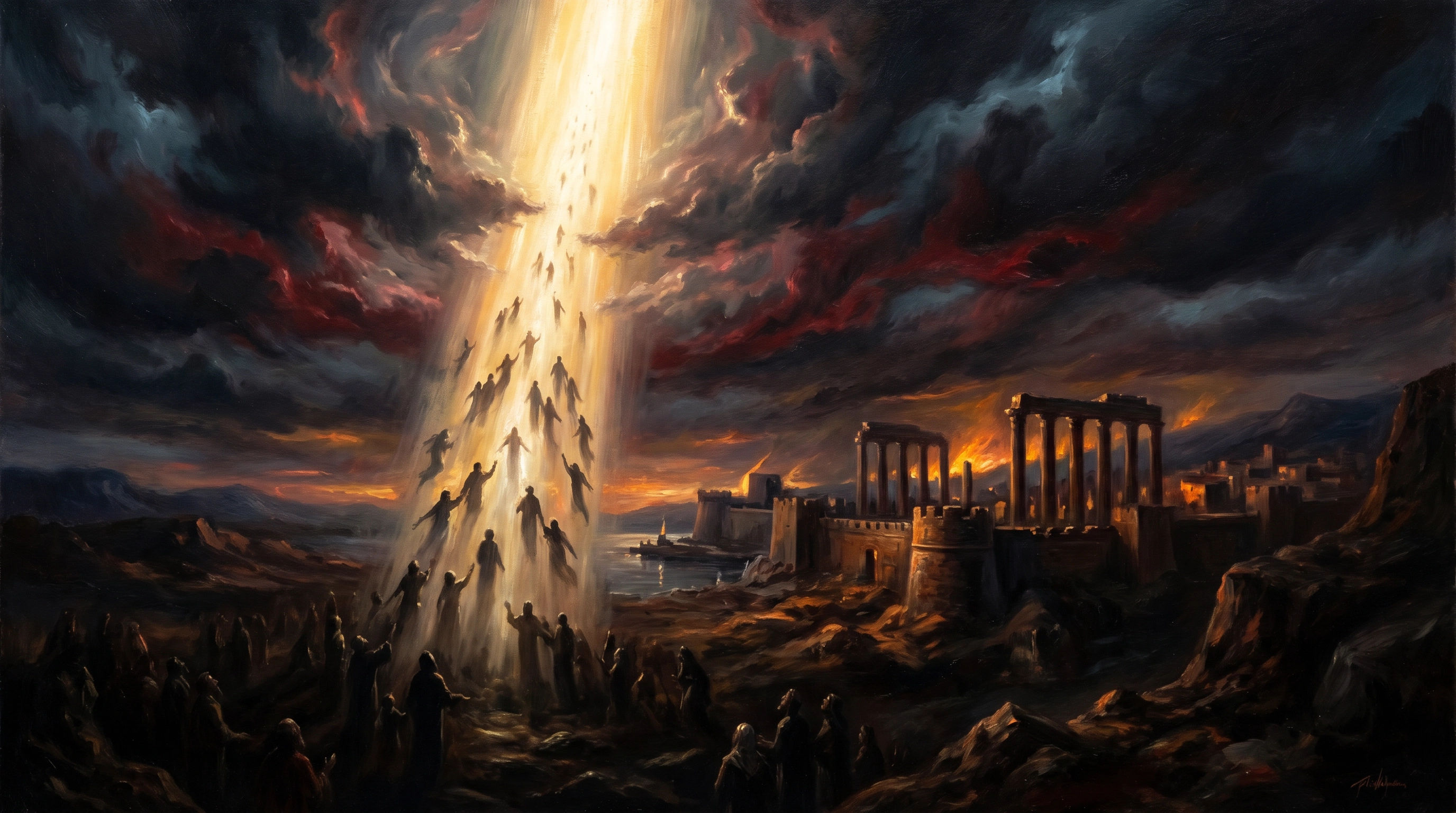
When Paul wrote to the grieving believers in Thessalonica, he gave them the most detailed description of the Rapture in all of Scripture. Study 1 Thessalonians 4:13-18 and 2 Thessalonians 2 verse by verse: the shout, the trumpet, the dead rising first, and the Man of Lawlessness who must come before the Day of the Lord.
Why Paul Wrote to Thessalonica
The church at Thessalonica was young, persecuted, and confused. Paul had planted it on his second missionary journey (Acts 17:1-9) but was driven out after only three weeks by a mob organized by jealous Jewish leaders. He left behind a congregation of new believers who had no complete New Testament, no trained elders, and no clear answers about what would happen to their loved ones who had already died before Jesus returned.
Their question was urgent and pastoral: If Jesus comes back before we die, what happens to the believers who are already in the grave? Have they missed the resurrection?
Paul's answer in 1 Thessalonians 4:13-18 is the most detailed description of the Rapture in all of Scripture -- and it was written not as a theological treatise but as a letter of comfort to grieving people.
1 Thessalonians 4:13-18 -- The Rapture Passage
"But we do not want you to be uninformed, brothers, about those who are asleep, that you may not grieve as others do who have no hope. For since we believe that Jesus died and rose again, even so, through Jesus, God will bring with him those who have fallen asleep. For this we declare to you by a word from the Lord, that we who are alive, who are left until the coming of the Lord, will not precede those who have fallen asleep. For the Lord himself will descend from heaven with a cry of command, with the voice of an archangel, and with the sound of the trumpet of God. And the dead in Christ will rise first. Then we who are alive, who are left, will be caught up together with them in the clouds to meet the Lord in the air, and so we will always be with the Lord. Therefore encourage one another with these words." -- 1 Thessalonians 4:13-18 (ESV)
Read 1 Thessalonians 4 in context
Open the full chapter with AI commentary, cross-references, and multiple translations — free, no account required.
Paul structures his answer around a single foundational truth: because Jesus died and rose again, those who die in Christ will also rise. The resurrection of Jesus is the guarantee of the resurrection of believers. This is not wishful thinking -- it is the logical consequence of the gospel.
Key Greek Words in 1 Thessalonians 4
Harpazo (v.17) -- "Caught Up"
The word translated "caught up" is harpazo, which means to seize, snatch, or carry off by force. It is used in Acts 8:39 when the Spirit "snatched away" Philip after he baptized the Ethiopian eunuch. It appears in 2 Corinthians 12:2-4 when Paul describes being "caught up to the third heaven." In Revelation 12:5, the male child is "caught up" to God and His throne.
When Jerome translated the Greek New Testament into Latin (the Vulgate), he rendered harpazo as rapturo -- from which the English word "Rapture" derives. The word carries the sense of a sudden, forceful, irresistible action. This is not a gentle invitation; it is a divine seizure.
Parousia (v.15) -- "Coming"
The Greek word parousia means "presence" or "arrival" and was used in the ancient world to describe the official visit of a king or emperor to a city. The city would go out to meet the dignitary on the road and escort him back in. This is exactly the imagery Paul uses: believers are "caught up to meet the Lord in the air" -- not to stay in the air, but to escort the returning King back to earth.
Koimaomai (v.13) -- "Asleep"
Paul uses the word koimaomai ("sleep") as a euphemism for physical death. This was common in early Christian vocabulary (see John 11:11, Acts 7:60) and reflects the Christian conviction that death is not the end but a temporary state from which believers will be awakened. Paul is careful to say he does not want them to grieve "as others do who have no hope" -- not that they should not grieve at all, but that their grief should be shaped by the resurrection hope.
The Sequence of Events in 4:16-17
Paul describes a precise sequence:
| Step | Event | Detail |
|---|---|---|
| 1 | The Lord descends | From heaven, personally |
| 2 | Three sounds | Shout of command, archangel's voice, trumpet of God |
| 3 | Dead in Christ rise first | Resurrection precedes the living believers' transformation |
| 4 | Living believers caught up | Together with the resurrected dead |
| 5 | Meeting in the clouds | The parousia -- escorting the King |
| 6 | Always with the Lord | The eternal state begins |
The emphasis on "the dead in Christ will rise first" directly answers the Thessalonians' fear. Their deceased loved ones will not miss the event -- they will actually lead the procession.
1 Thessalonians 5:1-11 -- Children of Light
Immediately after describing the Rapture, Paul pivots to the timing question: when will this happen?
"Now concerning the times and the seasons, brothers, you have no need to have anything written to you. For you yourselves are fully aware that the day of the Lord will come like a thief in the night. While people are saying, 'There is peace and security,' then sudden destruction will come upon them as labor pains come upon a pregnant woman, and they will not escape. But you are not in darkness, brothers, for that day to surprise you like a thief. For you are all children of light, children of the day." -- 1 Thessalonians 5:1-4 (ESV)
Paul makes a sharp distinction between two groups. Those in darkness -- the unbelieving world -- will be caught completely off guard. The phrase "peace and security" may echo Roman imperial propaganda; the Pax Romana promised exactly this. But sudden destruction will come "as labor pains come upon a pregnant woman" -- unavoidable, intensifying, and impossible to stop once begun.
Children of light -- believers -- are not in darkness. They know the season even if they do not know the day or hour. Paul's exhortation is not to calculate dates but to live in a state of sober readiness: "So then let us not sleep, as others do, but let us keep awake and be sober" (v.6).
The theological anchor of this section is verse 9: "For God has not destined us for wrath, but to obtain salvation through our Lord Jesus Christ." This verse is central to the pre-tribulation Rapture argument: if the Tribulation is characterized as God's wrath, and if believers are not destined for wrath, then believers will be removed before the Tribulation begins.
2 Thessalonians 2:1-12 -- The Man of Lawlessness
Paul's second letter to Thessalonica addresses a new crisis: someone had forged a letter in Paul's name claiming that the Day of the Lord had already come (2:2). The Thessalonians were shaken and alarmed. Paul's response is one of the most important eschatological passages in the New Testament.
"Let no one deceive you in any way. For that day will not come, unless the rebellion comes first, and the man of lawlessness is revealed, the son of destruction, who opposes and exalts himself against every so-called god or object of worship, so that he takes his seat in the temple of God, proclaiming himself to be God." -- 2 Thessalonians 2:3-4 (ESV)
Paul identifies two events that must precede the Day of the Lord.
1. The Apostasy (apostasia)
The Greek word apostasia means a deliberate departure or defection from previously held truth. This is not merely moral decline but a specific, end-times rebellion against God -- a global rejection of Christian truth on a scale unprecedented in history. Paul describes it as "the rebellion" (with the definite article), suggesting a specific, identifiable event rather than a gradual trend.
2. The Revelation of the Man of Lawlessness
This figure -- also called "the son of destruction" (the same phrase used of Judas in John 17:12) -- is the Antichrist. Paul describes him in terms that echo Daniel 11:36-37 and Ezekiel 28:2: he "opposes and exalts himself against every so-called god or object of worship" and "takes his seat in the temple of God, proclaiming himself to be God."
This act -- the Antichrist sitting in the rebuilt Jerusalem temple and claiming to be God -- is what Jesus called "the abomination of desolation" in Matthew 24:15, quoting Daniel 9:27. It marks the midpoint of the seven-year Tribulation and triggers the Great Tribulation.
The Restrainer (2 Thessalonians 2:6-7)
"And you know what is restraining him now so that he may be revealed in his time. For the mystery of lawlessness is already at work. Only he who now restrains it will do so until he is out of the way." -- 2 Thessalonians 2:6-7 (ESV)
Paul uses two different grammatical forms for the restrainer:
| Form | Greek | Meaning |
|---|---|---|
| Neuter (to katechon, v.6) | "what is restraining" | An impersonal force or principle |
| Masculine (ho katechon, v.7) | "he who now restrains" | A personal agent |
The most widely held evangelical interpretation is that the restrainer is the Holy Spirit working through the Church. When the Church is removed at the Rapture, the restraining influence of the Spirit-indwelt community of believers is withdrawn, and the Antichrist is free to be revealed. This interpretation fits the dual neuter/masculine usage: the Spirit (neuter in Greek) working through the Church (a corporate body with personal members).
Other views include the Roman Empire/Emperor (Paul's original audience), the archangel Michael (Daniel 12:1), and human government in general (Romans 13:1-4).
The Fate of the Man of Lawlessness
Paul's description of the Antichrist's end is brief but decisive:
"And then the lawless one will be revealed, whom the Lord Jesus will kill with the breath of his mouth and bring to nothing by the appearance of his coming." -- 2 Thessalonians 2:8 (ESV)
Two instruments of destruction are named. First, "the breath of his mouth" -- an echo of Isaiah 11:4, where the Branch of Jesse "shall strike the earth with the rod of his mouth, and with the breath of his lips he shall kill the wicked." The Antichrist, for all his supernatural power and global dominion, is destroyed by a single word from Jesus.
Second, "the appearance of his coming" -- the Greek epiphaneia tes parousias combines two words for the Second Coming. The mere appearance of Jesus is sufficient to annihilate the Man of Lawlessness. This is the same figure who will have deceived the entire world with "false signs and wonders" (v.9) -- and he is undone by a glance.
Connecting the Thessalonian Letters to the End Times Series
The Thessalonian letters serve as the New Testament bridge between the Old Testament prophets (Daniel, Isaiah, Joel) and the final revelation of John. The chart below shows how the key events Paul describes map onto the broader End Times timeline:
| Event | Thessalonians Reference | OT Parallel | Revelation Parallel |
|---|---|---|---|
| Rapture | 1 Thess 4:13-18 | -- | Rev 4:1 (symbolic) |
| Day of the Lord begins | 1 Thess 5:2-3 | Joel 2:1; Zeph 1:14-18 | Rev 6:1 (First Seal) |
| Apostasy | 2 Thess 2:3 | Dan 11:36-37 | Rev 13:4-8 |
| Abomination of Desolation | 2 Thess 2:4 | Dan 9:27; Matt 24:15 | Rev 13:14-15 |
| Antichrist's destruction | 2 Thess 2:8 | Isa 11:4; Dan 7:11 | Rev 19:20 |
Practical Application: What Paul Wants You to Do
Paul does not end either letter with a prophecy chart. He ends with pastoral exhortations.
In 1 Thessalonians 4:18: "Therefore encourage one another with these words." The Rapture is not primarily a theological debate topic -- it is a source of comfort for people who have lost loved ones. The resurrection hope is meant to change how we grieve.
In 1 Thessalonians 5:6-8: "Let us keep awake and be sober." The proper response to knowing the season is not anxiety or obsessive date-setting but sober, alert, purposeful living. Paul uses the imagery of a soldier putting on armor: faith and love as a breastplate, the hope of salvation as a helmet.
In 2 Thessalonians 2:15: "Stand firm and hold to the traditions that you were taught by us." In a world of eschatological confusion and forged letters, the antidote is not more speculation but a firm grip on apostolic teaching. Paul's instruction is to go back to what was handed down, not forward into novelty.
Recommended Reading
For deeper study of the Thessalonian letters and their eschatological teaching, two books stand out:
The Rapture Question by John F. Walvoord -- The definitive pre-tribulation Rapture argument from the former president of Dallas Theological Seminary. Walvoord systematically examines every major Rapture passage, including the Thessalonian letters, and responds to mid- and post-tribulation objections with careful exegesis.
The End Times in Chronological Order by Ron Rhodes -- A clear, accessible guide to the entire prophetic timeline from the Rapture through the Eternal State. Rhodes devotes significant attention to the Thessalonian letters and shows how they fit into the broader sequence of end-times events. Ideal for readers who want a comprehensive overview without getting lost in technical debates.
This is Part 4 of our ten-part End Times series. Go back to Part 3: Daniel 9 -- The 70 Weeks Prophecy [blocked] or continue to Part 5: The Seven Seals of Revelation 6 [blocked].
Recommended Reading
Deepen your study with these hand-picked books related to this article.

Be Rich (Ephesians)
Warren W. Wiersbe
Verse-by-verse Ephesians commentary revealing the countercultural nature of the Gospel and the riches believers already possess.
The Whole Armor of God
Iain M. Duguid
Unpacks each piece of spiritual armor Paul describes in Ephesians 6, inviting believers to take up the armor each day in Christ's victory.
The Screwtape Letters
C.S. Lewis
A satirical masterpiece told through letters from a senior demon to his nephew on the art of temptation.
As an Amazon Associate, BibleCompass earns from qualifying purchases.
Get the 7-Day Holy Week Devotional
Palm Sunday → Resurrection Sunday — free, delivered to your inbox
Related Articles
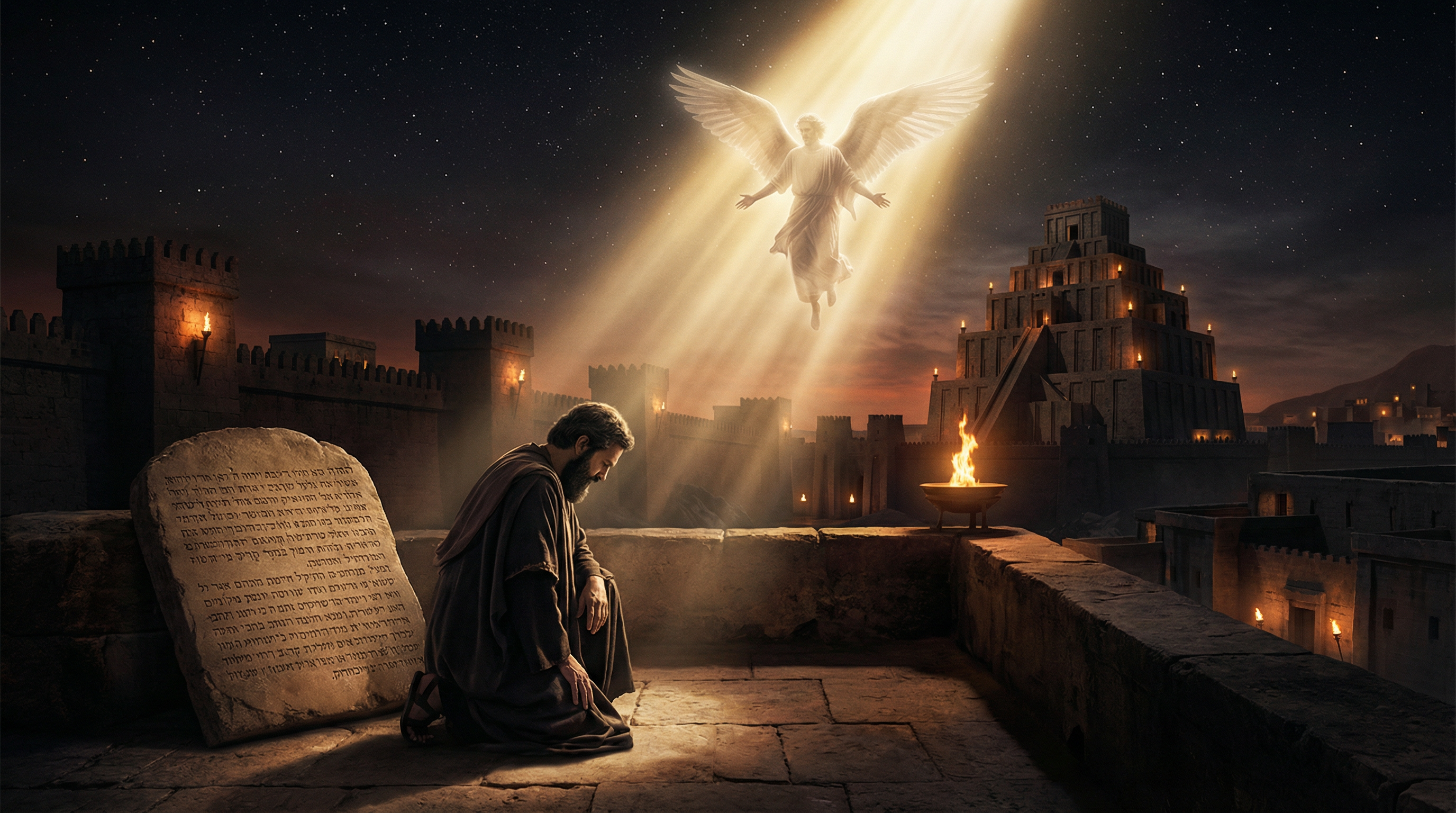
Daniel 9: The 70 Weeks Prophecy -- A Timeline for the End
Daniel 9:24-27 is the most mathematically precise prophecy in all of Scripture -- 70 weeks of years that pinpoint the coming of the Messiah, the destruction of Jerusalem, and a final seven-year period at the end of history. Study it verse by verse.
Revelation 6: The Seven Seals and the Four Horsemen of the Apocalypse
When the Lamb opens the seven seals in Revelation 6, history's final chapter begins. This verse-by-verse study examines each seal judgment — from the four horsemen to the martyrs' cry to the cosmic shaking of the sixth seal — and shows how they connect to Daniel, Matthew 24, and Paul's letters.
Daniel 2 & 7: The Four Kingdoms and the Son of Man
Daniel 2 and 7 are parallel prophecies that map the same sweep of history — four world empires, a terrifying fourth beast, and the Son of Man who receives an eternal kingdom. Study both visions verse by verse.
Community Discussion
(0)Sign in to join the discussion.
No comments yet. Be the first to share your thoughts!
Continue Your Study
Explore the Bible with Scripture-grounded commentary, cross-references, and study tools.