Daniel 2 & 7: The Four Kingdoms and the Son of Man
Daniel 2 and 7 are parallel prophecies that map the same sweep of history — four world empires, a terrifying fourth beast, and the Son of Man who receives an eternal kingdom. Study both visions verse by verse.
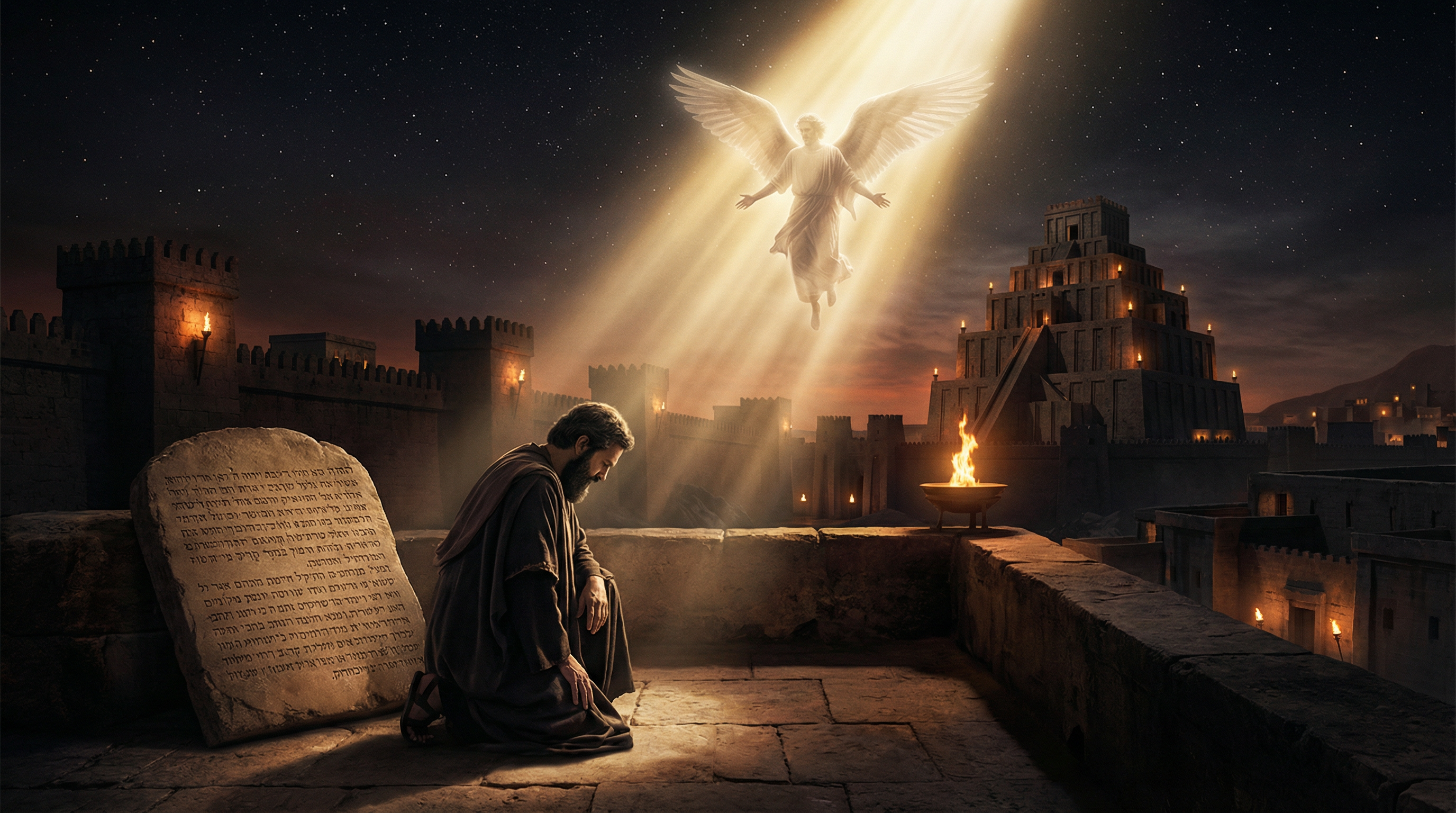
In Part 1 of this series [blocked] we stood on the Mount of Olives with Jesus and heard Him describe the signs that would precede His return. But the story of biblical prophecy does not begin in the New Testament. Centuries before Christ walked the earth, a Jewish exile named Daniel received two of the most sweeping prophetic visions in all of Scripture — visions that Jesus Himself referenced when He spoke of "the Son of Man coming on the clouds of heaven" (Matthew 24:30, ESV).
Daniel 2 and Daniel 7 are parallel prophecies. They cover the same sweep of history from two different vantage points: one given to a pagan king in a dream, the other given to Daniel himself in a night vision. Together they form a prophetic scaffold that runs from the Babylonian Empire all the way to the eternal kingdom of God. Understanding them is essential for understanding everything the New Testament says about the end times.
The Dream That Terrified a King (Daniel 2:1–13)
"In the second year of the reign of Nebuchadnezzar, Nebuchadnezzar had dreams; his spirit was troubled, and his sleep left him." — Daniel 2:1 (ESV)
Read Daniel 7 in context
Open the full chapter with AI commentary, cross-references, and multiple translations — free, no account required.
The Hebrew word translated "troubled" is pa'am (פָּעַם), which carries the sense of being beaten or agitated — like a hammer striking metal. This was not ordinary anxiety. Nebuchadnezzar, the most powerful man on earth, was shaken to his core by a dream he could not remember but could not forget.
His demand was extraordinary: he commanded his wise men not only to interpret the dream but to tell him what the dream was — without being told. When they protested that no one could do such a thing, he ordered the execution of all the wise men of Babylon, a sentence that included Daniel and his three companions.
This crisis is the context for one of the most important theological statements in the book: "There is a God in heaven who reveals mysteries" (Daniel 2:28, ESV). Before the content of the dream is even given, the reader is told who holds the knowledge of the future. It is not the astrologers, not the enchanters, not the king — it is the God of Israel.
The Statue and the Stone (Daniel 2:31–45)
"You saw, O king, and behold, a great image. This image, mighty and of exceeding brightness, stood before you, and its appearance was frightening." — Daniel 2:31 (ESV)
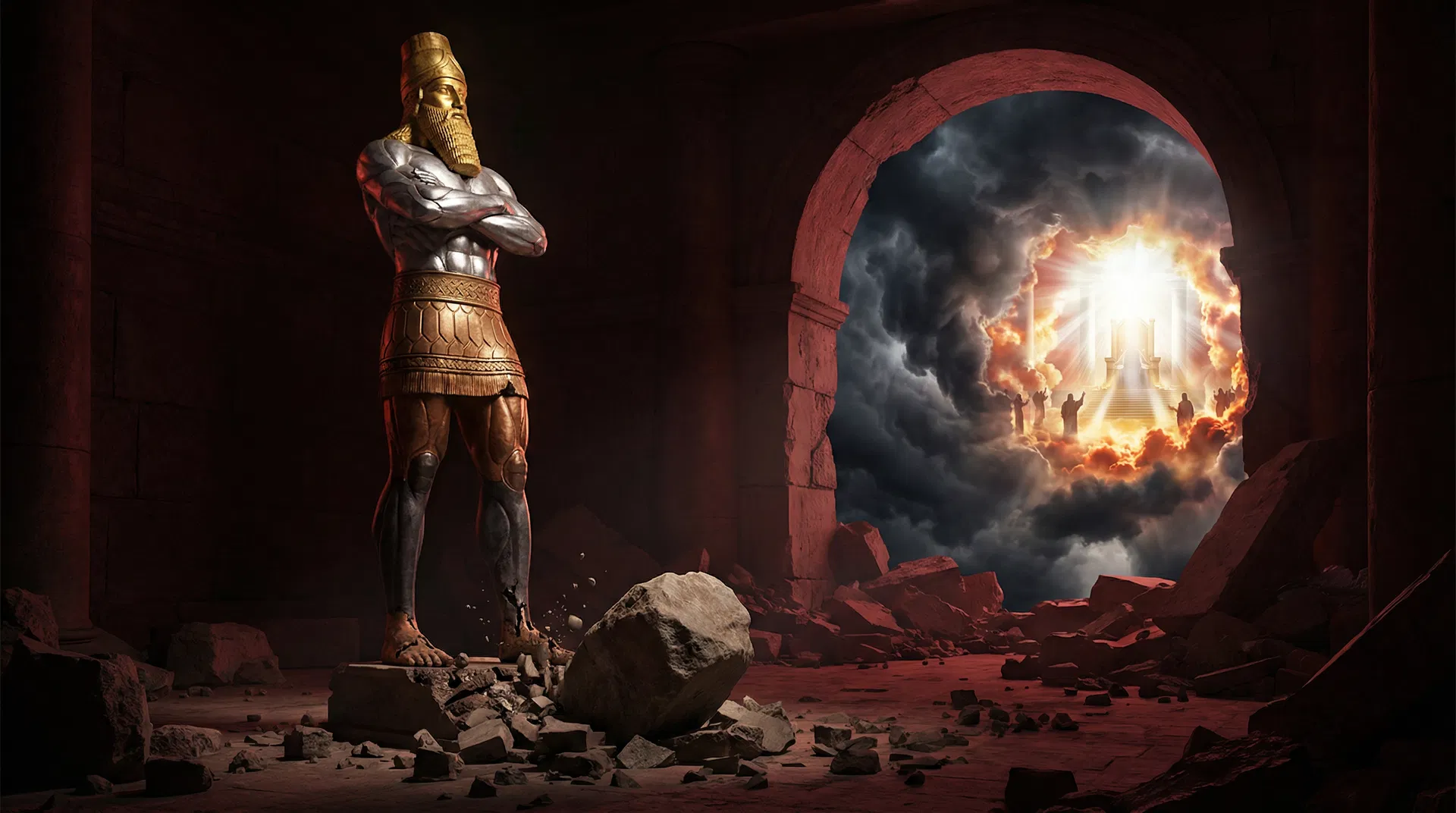
The statue Nebuchadnezzar saw was composed of four distinct materials, each representing a successive world empire. The head of gold was Babylon itself — Nebuchadnezzar's own kingdom. The silver chest and arms represented Medo-Persia, the empire that would conquer Babylon in 539 BC. The bronze belly and thighs pointed to Greece under Alexander the Great, whose armies swept from Macedonia to India in just thirteen years. The iron legs represented Rome, the empire that crushed and shattered everything before it.
The Aramaic word for "kingdom" here is malkû (מַלְכוּ), the same root used throughout Daniel for the sovereign reign of God. The four earthly kingdoms are not presented as equals — each is less glorious than the one before, from gold to clay. This descending value is deliberate: history, in the biblical worldview, does not progress toward utopia under human rule. It declines.
But the dream does not end with the statue. A stone "cut out by no human hand" strikes the feet of the statue, shatters the entire image, and becomes a great mountain that fills the whole earth (Daniel 2:34–35, ESV). Daniel's interpretation is explicit: "And in the days of those kings the God of heaven will set up a kingdom that shall never be destroyed" (Daniel 2:44, ESV).
The stone is the kingdom of God — a kingdom not built by political power or military conquest but established by divine act. This is the first great prophetic announcement of what the New Testament will call the kingdom of heaven.
Reading Daniel alongside a good commentary deepens the study considerably. John F. Walvoord's classic Daniel: The Key to Prophetic Revelation provides thorough verse-by-verse exposition of both chapters from a dispensational perspective.

The Same Vision from Below (Daniel 7:1–8)
"And four great beasts came up out of the sea, different from one another." — Daniel 7:3 (ESV)
Where Daniel 2 showed the kingdoms from the perspective of human grandeur — a magnificent statue of precious metals — Daniel 7 shows the same kingdoms from God's perspective: wild, predatory beasts rising from a churning sea.
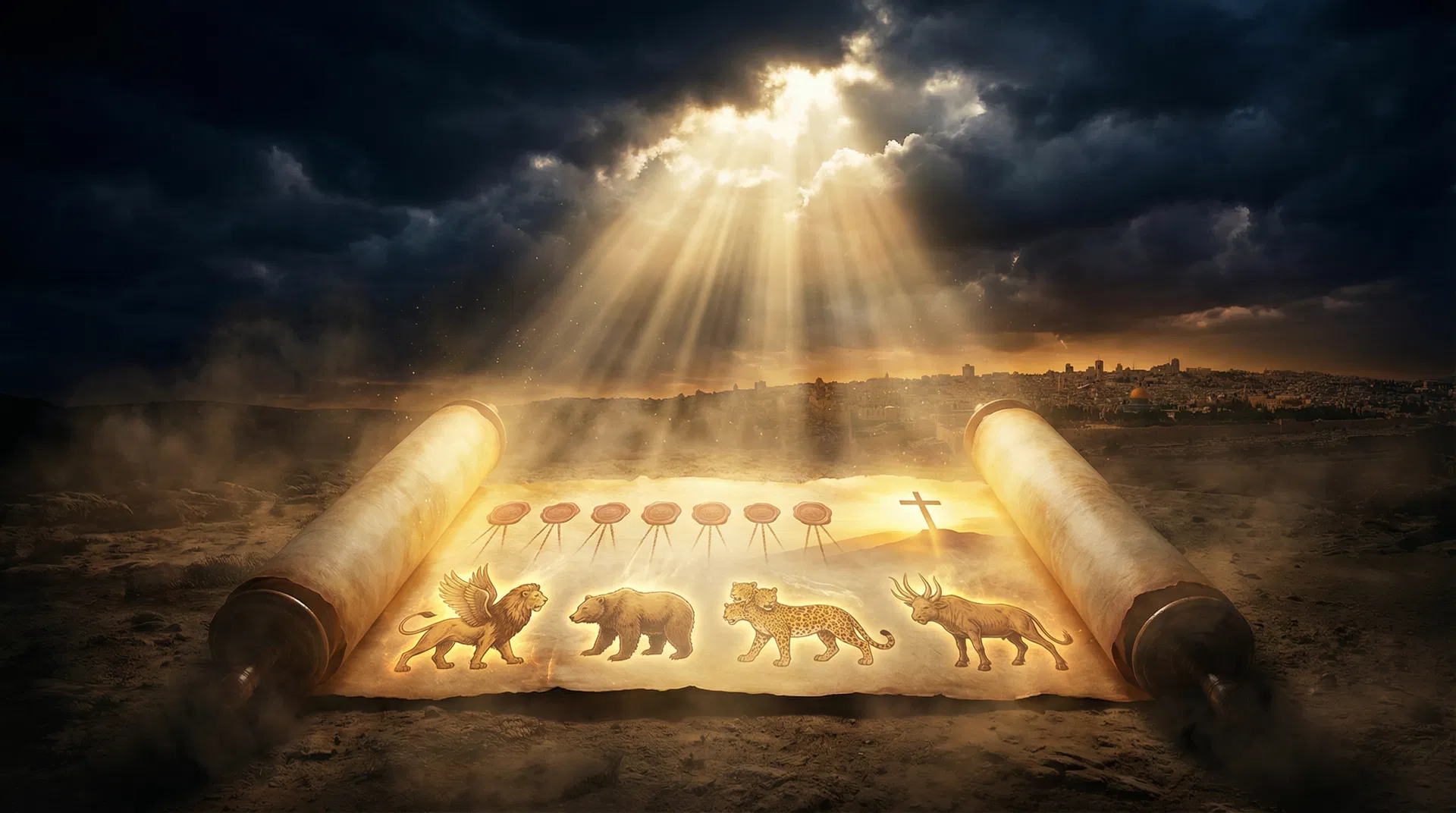
The four beasts correspond to the four parts of the statue. The first beast, a lion with eagle's wings that were plucked and made to stand like a man, represents Babylon. The second beast, a bear raised on one side with three ribs in its mouth, represents Medo-Persia — the three ribs likely pointing to the three major conquests of Babylon, Lydia, and Egypt. The third beast, a leopard with four wings and four heads, represents Greece — the four heads corresponding to the four divisions of Alexander's empire after his death. The fourth beast, described only as terrifying and dreadful with iron teeth and ten horns, represents Rome and its final manifestation.
The Aramaic word for "sea" (yamma, יַמָּא) in Jewish apocalyptic literature consistently represents the chaotic nations of the world in rebellion against God (cf. Isaiah 17:12–13, Revelation 17:15). The beasts do not rise from peaceful waters — they emerge from chaos. This is a theological statement about the nature of human empire: it is not the product of civilization but of violence and disorder.
The fourth beast receives the most attention. It has iron teeth (echoing the iron legs of Daniel 2), ten horns, and then an eleventh "little horn" that uproots three of the first ten and speaks "great things" — a phrase the New Testament applies to the Antichrist (Revelation 13:5). This little horn wages war against "the saints" and prevails — until the Ancient of Days takes His seat.
The Ancient of Days and the Son of Man (Daniel 7:9–14)
"I saw in the night visions, and behold, with the clouds of heaven there came one like a son of man, and he came to the Ancient of Days and was presented before him." — Daniel 7:13 (ESV)
This is the theological summit of the entire book of Daniel. Two figures appear: the Ancient of Days, seated on a flaming throne with a river of fire flowing before Him, and "one like a son of man" who approaches Him on the clouds.
The Aramaic phrase bar 'enash (בַּר אֱנָשׁ), "son of man," is deliberately ambiguous. It means "a human being" — but this human being rides the clouds, which in the Hebrew Bible is exclusively the domain of God (Psalm 68:4, Isaiah 19:1). The figure is simultaneously human and divine.
He is "presented before" the Ancient of Days — a throne-room presentation, a formal investiture — and receives "dominion and glory and a kingdom, that all peoples, nations, and languages should serve him" (Daniel 7:14, ESV). His kingdom is described with three superlatives: it is everlasting, it shall not pass away, and it shall not be destroyed.
Jesus quotes this passage directly in His trial before the Sanhedrin: "You will see the Son of Man seated at the right hand of Power and coming on the clouds of heaven" (Matthew 26:64, ESV). By applying Daniel 7:13 to Himself, Jesus was making a claim that the high priest immediately recognized as blasphemy — or as the truth. There was no middle ground.
The Interpretation and the Saints (Daniel 7:15–28)
"But the saints of the Most High shall receive the kingdom and possess the kingdom forever, forever and ever." — Daniel 7:18 (ESV)
The angel's interpretation of the vision contains a detail that is easy to overlook: the kingdom given to the Son of Man is also given to "the saints of the Most High." The Aramaic word qaddishin (קַדִּישִׁין) means "holy ones" — the people of God who have remained faithful through the persecution of the fourth beast.
This is the same pattern Paul describes in Romans 8:17 — heirs of God and co-heirs with Christ, sharing in both His suffering and His glory. The kingdom is not given to the Son of Man alone; it is given to Him and to those who belong to Him.
The angel also specifies the duration of the little horn's persecution: "a time, times, and half a time" (Daniel 7:25, ESV). The Aramaic idiom 'iddan we'iddanin uflag 'iddan represents 3.5 years — a period that appears again in Revelation 12:14 and 13:5 as the duration of the Antichrist's authority. This numerical link between Daniel and Revelation is one of the strongest arguments for reading the two books as a unified prophetic narrative.
Applying Daniel 2 and 7 Today
Daniel received these visions while living as a captive in a foreign empire. Babylon was not a footnote in history — it was the superpower of the ancient world, and it had destroyed Jerusalem, burned the Temple, and carried God's people into exile. From a human perspective, the God of Israel appeared to have lost.
The visions of Daniel 2 and 7 were given precisely to counter that appearance. They declare that no empire — not Babylon, not Persia, not Greece, not Rome, not any future power — is the final word on history. Every kingdom built on human ambition is temporary. The only kingdom that will never be destroyed is the one given to the Son of Man.
This is not merely a theological abstraction. It is a pastoral word for anyone living under circumstances that feel permanent and overwhelming. The stone cut without human hands is still moving. The Ancient of Days is still seated on His throne. The Son of Man has already been presented before Him and received His kingdom — and He is coming to make it fully visible. That is the hope that sustained Daniel in Babylon, and it is the same hope that sustains the church today.
This is Part 2 of our ten-part End Times series. The next article examines Revelation 6 — the opening of the seven seals and the four horsemen of the apocalypse. Read Part 3: The Four Horsemen → [blocked]
Daniel 2 and 7 are best understood alongside the chapters that surround them. The BibleCompass Bible Reader includes verse-by-verse commentary on every chapter of Daniel — including the Aramaic sections, the word studies, and the connections to Revelation. Open Daniel 7 in the Reader → [blocked]
Recommended Reading
For a verse-by-verse commentary on Daniel 2 and 7 from a doctrinally precise perspective, John F. Walvoord's Daniel: The Key to Prophetic Revelation provides thorough exposition of every chapter.
For a Reformed perspective on Daniel's prophecies, Edward J. Young's The Prophecy of Daniel offers careful exegesis of the Son of Man passage and its New Testament fulfillment.

Recommended Reading
Deepen your study with these hand-picked books related to this article.
The Difficult Passages in Revelation
Robert L. Furrow
Navigates the most challenging verses and topics in Revelation with biblical clarity and pastoral insight.
The Book of Signs
Dr. David Jeremiah
31 undeniable prophecies of the apocalypse, helping readers understand the signs of the end times.
Wiersbe Bible Commentary: New Testament
Warren W. Wiersbe
Complete New Testament commentary bringing decades of pastoral wisdom to every book from Matthew to Revelation.
As an Amazon Associate, BibleCompass earns from qualifying purchases.
Get the 7-Day Holy Week Devotional
Palm Sunday → Resurrection Sunday — free, delivered to your inbox
Related Articles
Daniel 9: The 70 Weeks Prophecy -- A Timeline for the End
Daniel 9:24-27 is the most mathematically precise prophecy in all of Scripture -- 70 weeks of years that pinpoint the coming of the Messiah, the destruction of Jerusalem, and a final seven-year period at the end of history. Study it verse by verse.
What Does the Bible Say About the End Times?
Nearly every book of the Bible touches on the end times. This introductory survey walks through the major prophetic themes — from Daniel's visions to Jesus's Olivet Discourse to the book of Revelation — and shows how the Old and New Testaments form a unified prophetic story.
Revelation 6: The Seven Seals and the Four Horsemen of the Apocalypse
When the Lamb opens the seven seals in Revelation 6, history's final chapter begins. This verse-by-verse study examines each seal judgment — from the four horsemen to the martyrs' cry to the cosmic shaking of the sixth seal — and shows how they connect to Daniel, Matthew 24, and Paul's letters.
Community Discussion
(0)Sign in to join the discussion.
Continue Your Study
Explore the Bible with Scripture-grounded commentary, cross-references, and study tools.