Matthew 24 and the Olivet Discourse: Jesus on the Signs of the End
Sitting on the Mount of Olives just days before His crucifixion, Jesus answered His disciples' most urgent question: What will be the sign of your coming and of the end of the age? Matthew 24 is His answer — a detailed prophetic roadmap covering false messiahs, wars, the abomination of desolation, the Great Tribulation, and the parable of the fig tree.
You are reading End Times Series — Part 1 of 12. Parts 2–13 are already published.
If you have ever looked at the headlines and felt a deep unease — a sense that something is fundamentally wrong with the world — you are asking the same question four disciples asked Jesus two thousand years ago. It was Tuesday of Holy Week, just days before the crucifixion. Jesus and His disciples had left the Jerusalem temple, and as they walked, the disciples pointed to the magnificent stone buildings of Herod's complex — structures so massive that some of the foundation stones weighed hundreds of tons. Jesus stopped them with a stunning prediction: "Not one stone here will be left on another; every one will be thrown down" (Matthew 24:2, ESV). Stunned, the disciples pulled Jesus aside on the Mount of Olives and asked three questions that have shaped Christian theology ever since: When will this happen? What will be the sign of your coming? And what will signal the end of the age? What follows in Matthew 24 is the most detailed prophetic discourse Jesus ever gave — a passage that connects the destruction of Jerusalem in AD 70 to the final events of world history. This is Part 1 of our twelve-part End Times series [blocked].
The Setting: A Question That Changed Everything
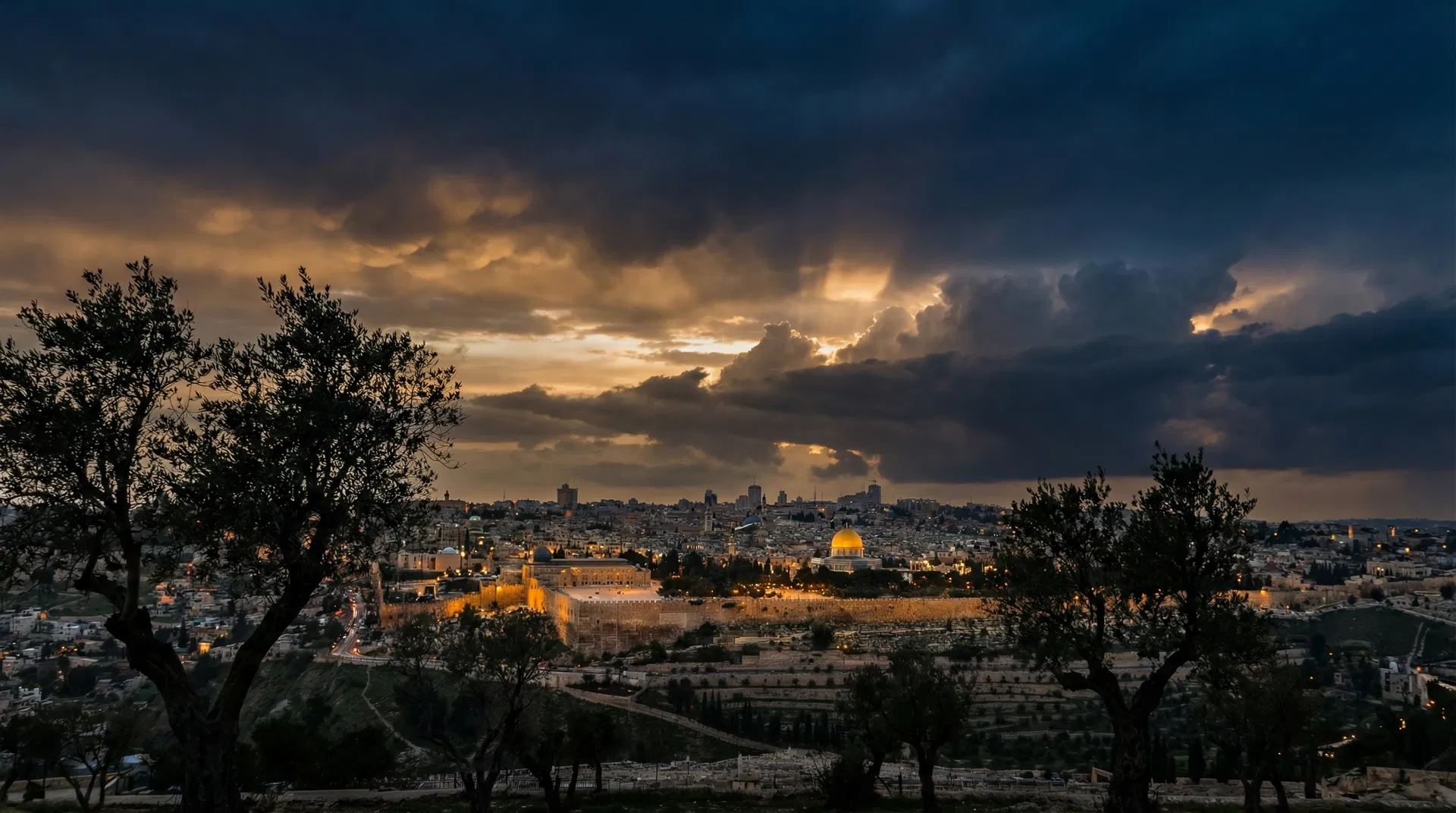
The Mount of Olives sits directly east of Jerusalem, separated from the city by the Kidron Valley. From its slopes, you can see the entire eastern face of the temple mount — the very view the disciples had when they asked their question. The Greek word translated "coming" in Matthew 24:3 is parousia (παρουσία), a technical term in the ancient world for the official arrival of a king or emperor. When a Roman emperor visited a province, his parousia was a major event — heralded in advance, accompanied by ceremony, and impossible to miss. The disciples were not asking about a secret or invisible return. They were asking about the moment when Jesus would arrive in full royal authority to establish His kingdom. His answer spans the rest of Matthew 24 and all of chapter 25.
Matthew 24:4-8 — False Messiahs and Birth Pangs
"And Jesus answered them, 'See that no one leads you astray. For many will come in my name, saying, "I am the Christ," and they will lead many astray. And you will hear of wars and rumors of wars. See that you are not alarmed, for this must take place, but the end is not yet. For nation will rise against nation, and kingdom against kingdom, and there will be famines and earthquakes in various places. All these are but the beginning of the birth pains.'" — Matthew 24:4-8 (ESV)
Read Matthew 24 in context
Open the full chapter with AI commentary, cross-references, and multiple translations — free, no account required.
Jesus begins not with a calendar but with a warning: do not be deceived. The first sign He lists is false messiahs — people claiming to be the Christ. History records dozens of such figures, from Simon bar Kokhba (who led a Jewish revolt in AD 132 and was hailed as the Messiah by Rabbi Akiva) to modern cult leaders who have claimed divine identity. Wars, famines, and earthquakes follow — events that have characterized every century of human history. Jesus does not say these things signal the immediate end; He says they are arche odinon (ἀρχὴ ὠδίνων) — "the beginning of birth pains." This is a crucial interpretive key. A woman in labor does not experience one contraction and immediately deliver; the pains begin gradually and intensify over time until the birth. Jesus is describing a pattern of increasing intensity, not a single moment. The signs will be present throughout the age, but they will accelerate and amplify as the end approaches.
Matthew 24:9-14 — Global Persecution and the Gospel
"Then they will deliver you up to tribulation and put you to death, and you will be hated by all nations for my name's sake. And then many will fall away and betray one another and hate one another. And many false prophets will arise and lead many astray. And because lawlessness will be increased, the love of many will grow cold. But the one who endures to the end will be saved. And this gospel of the kingdom will be proclaimed throughout the whole world as a testimony to all nations, and then the end will come." — Matthew 24:9, 14 (ESV)
Jesus describes a world in which followers of Christ face systematic persecution — not merely social disapproval, but death. The Greek word for "deliver up" is paradidomi (παραδίδωμι), the same word used to describe Judas handing Jesus over to the authorities. Believers will be handed over by governments, communities, and even family members. Alongside persecution comes a spiritual crisis: apostasia (ἀποστασία) — apostasy, a falling away from the faith. The love of many will grow cold as lawlessness increases. Yet in the middle of this darkness, Jesus gives a remarkable promise: the gospel of the kingdom will be proclaimed throughout the whole world before the end comes. This verse has driven Christian missions for two millennia and continues to motivate organizations working to translate the Bible into every remaining language. The end will not come until the message has reached every nation.
If you find this kind of verse-by-verse Bible study [blocked] helpful, Bible Compass provides commentary for every passage in the Bible. Try it free →
Matthew 24:15-22 — The Abomination of Desolation and the Great Tribulation
"So when you see the abomination of desolation spoken of by the prophet Daniel, standing in the holy place (let the reader understand), then let those who are in Judea flee to the mountains... For then there will be great tribulation, such as has not been from the beginning of the world until now, no, and never will be. And if those days had not been cut short, no human being would be saved. But for the sake of the elect those days will be cut short." — Matthew 24:15-16, 21-22 (ESV)
This is the pivotal moment in the entire discourse. Jesus quotes Daniel directly — a signal that Daniel's prophecies are literal and still future. The abomination of desolation (from the Hebrew shiqqutz shomem, שִׁקּוּץ שֹׁמֵם) refers to a sacrilegious act that renders the temple desolate. Daniel 9:27 describes the Antichrist breaking his covenant with Israel at the midpoint of a seven-year period and setting up an abomination in the temple. Paul confirms this in 2 Thessalonians 2:3-4, describing the "man of lawlessness" who "takes his seat in the temple of God, proclaiming himself to be God." When this happens, Jesus says, flee immediately — do not even go back into your house to get your cloak. The urgency is absolute.
What follows is the Great Tribulation — the Greek thlipsis megale (θλῖψις μεγάλη), literally "great pressure" or "great distress." Jesus uses the strongest possible language: this will be worse than anything that has ever happened in human history or ever will happen again. So severe will it be that if God did not cut those days short, no human being would survive. The phrase "cut short" (ekolobothesan, ἐκολοβώθησαν) means to amputate or truncate — God will sovereignly limit the duration of this period for the sake of His people.
Matthew 24:29-31 — The Return of the Son of Man
"Immediately after the tribulation of those days the sun will be darkened, and the moon will not give its light, and the stars will fall from heaven, and the powers of the heavens will be shaken. Then will appear in heaven the sign of the Son of Man, and then all the tribes of the earth will mourn, and they will see the Son of Man coming on the clouds of heaven with power and great glory. And he will send out his angels with a loud trumpet call, and they will gather his elect from the four winds, from one end of heaven to the other." — Matthew 24:29-31 (ESV)
The return of Christ is not subtle. Cosmic disturbances precede it — the sun darkened, the moon failing to give light, stars falling. These images echo the language of the Old Testament prophets (Isaiah 13:10; Joel 2:10; Amos 8:9) who used astronomical disruption as a symbol for divine judgment on a cosmic scale. Then the Son of Man — Jesus's preferred self-designation, drawn from Daniel 7:13-14 where the Son of Man receives an everlasting kingdom from the Ancient of Days — appears on the clouds with power and great glory. Every tribe on earth will mourn, recognizing too late what they have rejected. The angels will gather the elect from every corner of the earth. This is the visible, unmistakable, world-altering return that the disciples asked about when they used the word parousia.
Matthew 24:32-35 — The Parable of the Fig Tree
"From the fig tree learn its lesson: as soon as its branch becomes tender and puts out its leaves, you know that summer is near. So also, when you see all these things, you know that he is near, at the very gates. Truly, I say to you, this generation will not pass away until all these things take place. Heaven and earth will pass away, but my words will not pass away." — Matthew 24:32-35 (ESV)
The fig tree was a common symbol for Israel throughout the Old Testament (Hosea 9:10; Joel 1:7; Micah 7:1). When Jesus curses a barren fig tree earlier in Matthew 21, most scholars see it as a prophetic act symbolizing Israel's spiritual barrenness. Here, the fig tree putting out leaves — coming back to life — is the sign that summer (and the return of the King) is near. Many Bible scholars connect this parable to the re-establishment of the nation of Israel in 1948 after nearly two thousand years of dispersion, seeing it as the budding of the fig tree that Jesus foretold. The phrase "this generation will not pass away" has been interpreted variously, but the most natural reading in context is that the generation that sees all these signs — including the abomination of desolation — will also see the return of Christ. The cross-references between this passage and Daniel 9 [blocked] are among the most significant in all of prophetic Scripture.
Matthew 24:36-44 — Watch, for You Do Not Know the Hour
"But concerning that day and hour no one knows, not even the angels of heaven, nor the Son, but the Father only... Therefore, stay awake, for you do not know on what day your Lord is coming... Therefore you also must be ready, for the Son of Man is coming at an hour you do not expect." — Matthew 24:36, 42, 44 (ESV)
After giving detailed signs, Jesus ends with a paradox: no one knows the day or the hour. This is not a contradiction. The signs tell you the season; the Father alone knows the precise moment. The Greek word gregoreo (γρηγορέω), translated "stay awake" or "watch," means to be alert and vigilant — not paralyzed by fear or obsessed with date-setting, but living with the constant awareness that the King could return at any moment. Jesus uses two illustrations to make the point: the days of Noah (when people were eating and drinking normally until the flood came) and a homeowner who would have stayed awake if he had known a thief was coming. The application is not to calculate a date but to live in a state of readiness — with your affairs in order, your faith active, and your eyes on the horizon.
Applying Matthew 24 Today
Matthew 24 is not primarily a chart to be decoded or a timeline to be argued over. It is a pastoral letter from Jesus to His disciples — and to every generation of believers who would come after them. Two applications stand out.
First, do not be alarmed. Jesus says this explicitly in verse 6: "See that you are not alarmed, for this must take place." Wars, natural disasters, persecution, moral collapse — these are not signs that God has lost control. They are the birth pains of a new creation that is coming. The Christian response to world events is not panic but informed, Scripture-grounded hope. Understanding the prophetic framework of Matthew 24 means you can look at the headlines without despair, because you know how the story ends.
Second, live in readiness. The repeated command of Matthew 24 is to watch and be ready. This is not passive waiting but active faithfulness. Jesus's parable of the faithful servant (Matthew 24:45-51) describes a servant who keeps doing his master's work whether the master returns soon or late. The question Matthew 24 asks every reader is not "When will Jesus return?" but "What kind of person will you be when He does?"
This is Part 1 of our twelve-part End Times series. The next article examines Daniel 2 and 7 — the four great kingdoms and the vision of the Son of Man receiving an everlasting dominion. Read Part 2: Daniel's Four Kingdoms → [blocked]
Bible Compass provides verse-by-verse commentary, reading plans, and cross-reference tools for every passage in the Bible — including the complete prophetic books of Daniel and Revelation. Start your free study today →
Recommended Reading
For a verse-by-verse commentary on Matthew 24 from a doctrinally precise perspective, John MacArthur's Matthew 24–28 in the MacArthur New Testament Commentary series provides thorough exposition of every verse.

For a broader introduction to end times prophecy from an Israeli perspective, Amir Tsarfati's The Last Hour provides an accessible and compelling overview of the prophetic landscape.

Recommended Reading
Deepen your study with these hand-picked books related to this article.
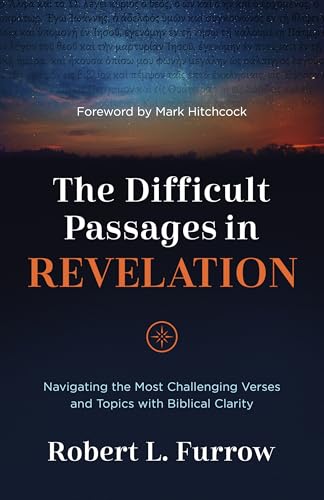
The Difficult Passages in Revelation
Robert L. Furrow
Navigates the most challenging verses and topics in Revelation with biblical clarity and pastoral insight.
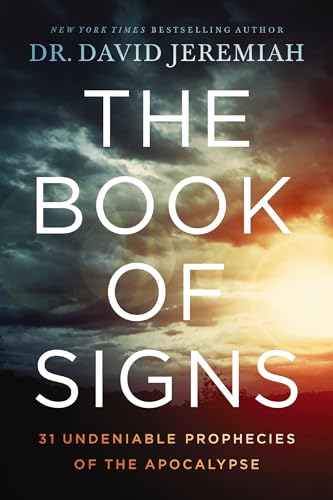
The Book of Signs
Dr. David Jeremiah
31 undeniable prophecies of the apocalypse, helping readers understand the signs of the end times.

The Second Coming
John MacArthur
MacArthur's definitive study of Christ's return — examining the signs, sequence, and significance of the Second Coming from Matthew 24 and Revelation 19.
As an Amazon Associate, Bible Compass earns from qualifying purchases.
Get the 7-Day Holy Week Devotional
Palm Sunday → Resurrection Sunday — free, delivered to your inbox
Related Articles
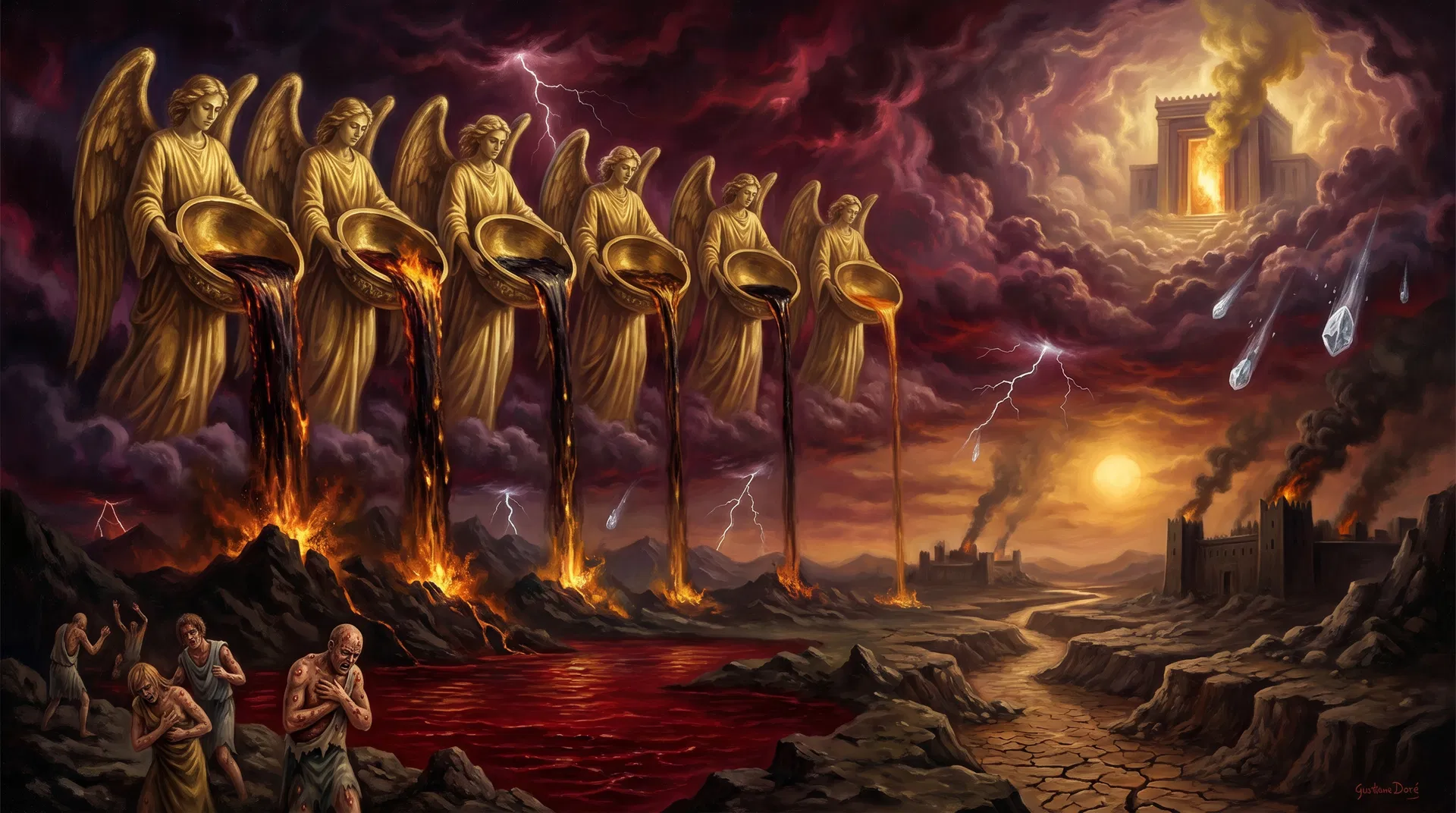
Revelation 15–16: The Seven Bowls of God’s Wrath
The seven bowls of Revelation 15–16 are the final, undiluted judgments of God — more severe than the seals and trumpets combined. This verse-by-verse study unpacks each bowl, the heavenly prelude in Revelation 15, the connection to the plagues of Exodus, and what these chapters reveal about the justice and holiness of God.
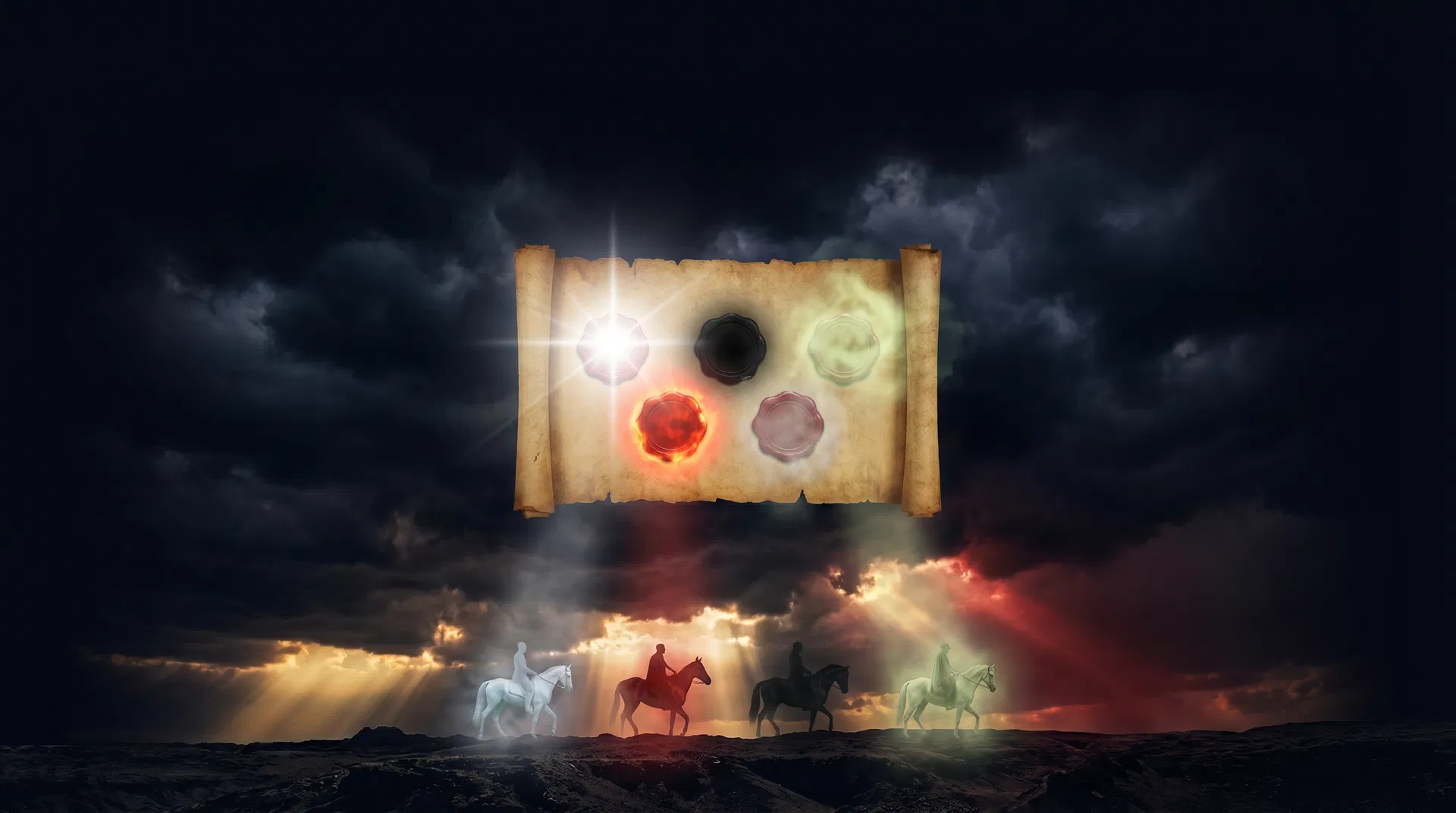
Revelation 6: The Seven Seals and the Four Horsemen of the Apocalypse
When the Lamb opens the seven seals in Revelation 6, history's final chapter begins. This verse-by-verse study examines each seal judgment — from the four horsemen to the martyrs' cry to the cosmic shaking of the sixth seal — and shows how they connect to Daniel, Matthew 24, and Paul's letters.
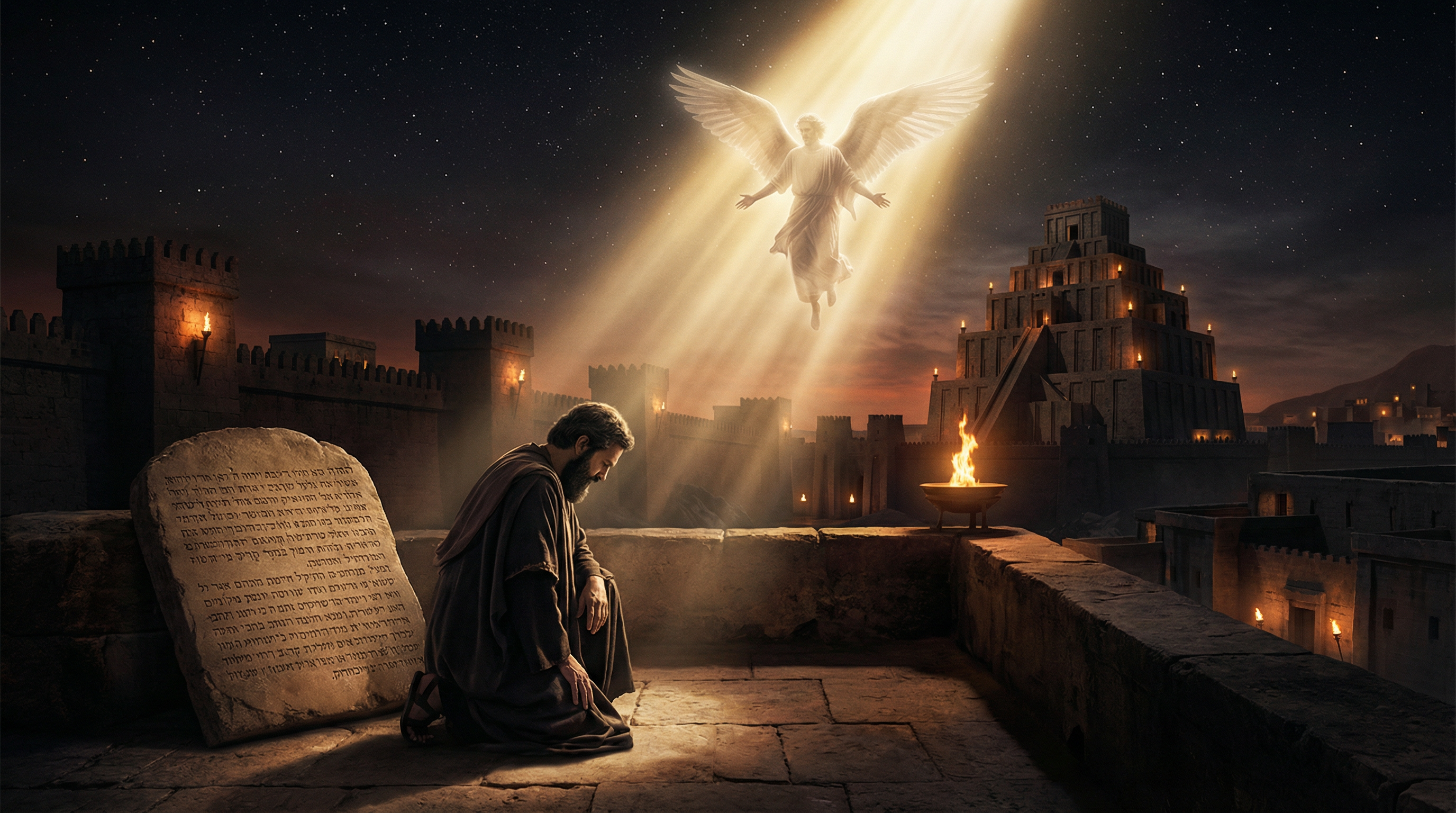
Daniel 9: The 70 Weeks Prophecy -- A Timeline for the End
Daniel 9:24-27 is the most mathematically precise prophecy in all of Scripture -- 70 weeks of years that pinpoint the coming of the Messiah, the destruction of Jerusalem, and a final seven-year period at the end of history. Study it verse by verse.
Reader Discussion
(0)Sign in to join the discussion.
No comments yet. Be the first to share your thoughts!
Continue Your Study
Explore the Bible with Scripture-grounded commentary, cross-references, and study tools.