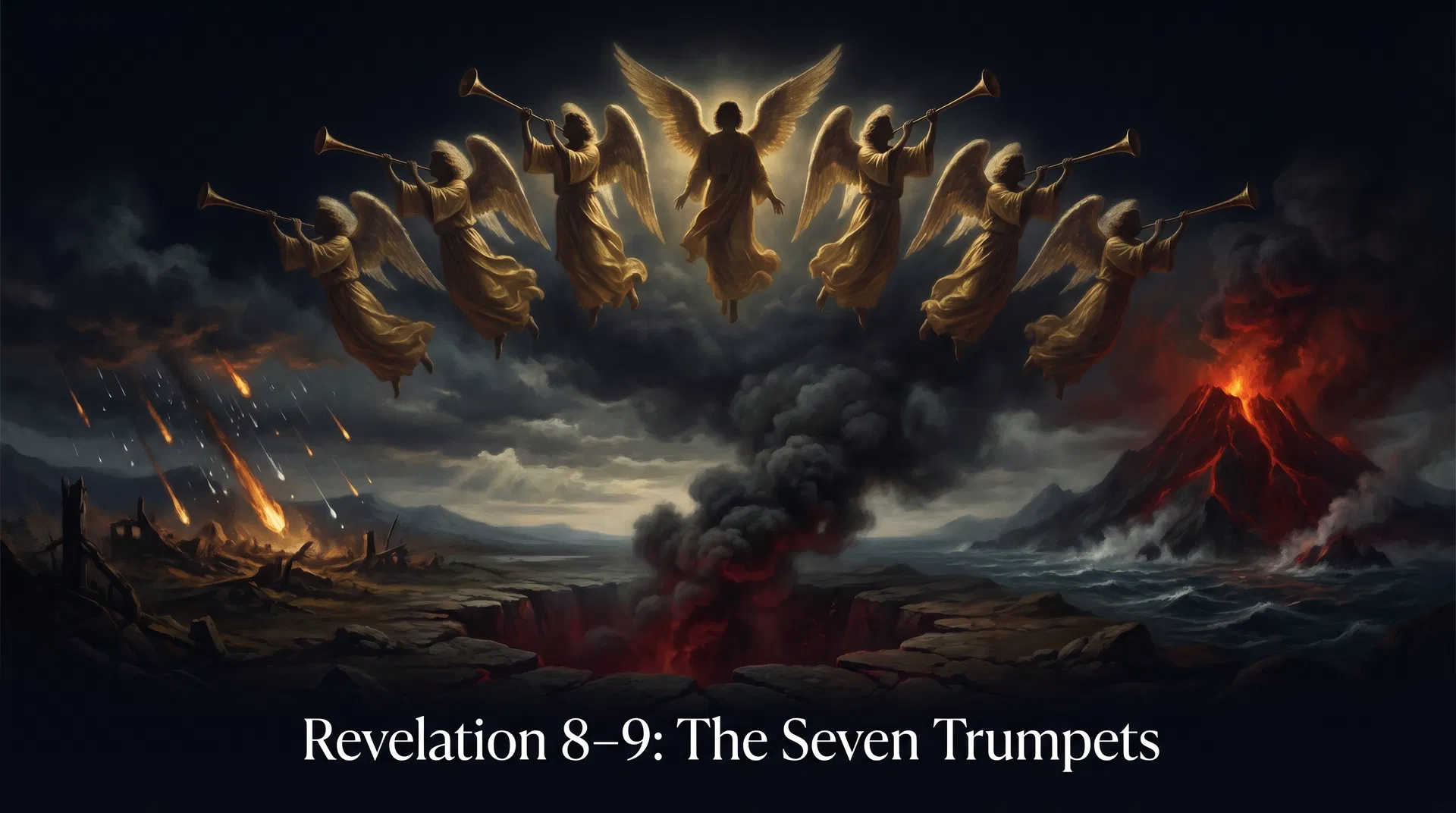
Revelation 8–9: The Seven Trumpets — God’s Escalating Warnings to a Rebellious World
The seven trumpets of Revelation 8–9 represent a dramatic escalation of divine judgment during the Tribulation — hail and fire, demonic locusts, and an army of two hundred million. Discover what each trumpet means and why humanity still refuses to repent.
You are reading End Times Series — Part 8 of 12. Parts 9–13 are already published.
In Part 7 of this series [blocked] we examined Ezekiel 38–39 and the great northern invasion of Israel that God supernaturally defeats. Now we return to the book of Revelation and enter the second major sequence of judgments — the seven trumpets of Revelation 8–9. If the seven seals were the opening act of the Tribulation, the trumpets are the escalation. This is Part 8 of our twelve-part End Times series [blocked].
If you have been following this series through the book of Revelation, you have already witnessed the opening of the seven seals — the Four Horsemen, the martyrs under the altar, and the cosmic shaking of the sixth seal. You may have wondered: can it get worse? Revelation 8–9 answers that question with a resounding yes. The seven trumpets represent a dramatic escalation of divine judgment — not arbitrary wrath, but the measured, purposeful warnings of a God who is giving a rebellious world every opportunity to repent before the final hour arrives.
These chapters are among the most vivid and terrifying in all of Scripture. Hail and fire, a burning mountain cast into the sea, a star falling from heaven, demonic locusts, and an army of two hundred million — the imagery is overwhelming. Yet beneath every judgment is a God who is sovereign, just, and still calling humanity to turn back to Him.
The Silence in Heaven and the Golden Censer (Revelation 8:1–5)
Before the first trumpet sounds, something extraordinary happens: heaven falls silent for half an hour.
"When the Lamb opened the seventh seal, there was silence in heaven for about half an hour." — Revelation 8:1 (ESV)
Read Revelation 8 in context
Open the full chapter with AI commentary, cross-references, and multiple translations — free, no account required.
In a book filled with thunderous praise and angelic proclamations, this silence is deafening. The Greek word for silence here is sigē — a complete, absolute quiet. Ancient Jewish worship understood silence before God as an act of solemn reverence, a recognition that something of ultimate gravity was about to unfold. The half-hour pause is heaven holding its breath.
Then an angel takes a golden censer, fills it with incense mixed with the prayers of the saints, and hurls it to the earth — and the trumpets begin. This is a profound theological statement: the judgments that follow are not disconnected from the prayers of God's people. The cries of the martyrs in Revelation 6:10 — "How long, O Lord?" — are being answered. God has not forgotten. He has been collecting every prayer, and now He acts.
The First Four Trumpets: Creation Under Assault (Revelation 8:6–12)
The first four trumpets strike the natural world in rapid succession, echoing the plagues of Egypt and signaling that the God who judged Pharaoh is now judging the whole earth.
"The first angel blew his trumpet, and there followed hail and fire, mixed with blood, and these were thrown upon the earth. And a third of the earth was burned up, a third of the trees were burned up, and all green grass was burned up." — Revelation 8:7 (ESV)
The pattern of "a third" — repeated throughout these verses — is significant. In Hebrew numerical symbolism, a third represents a severe but partial judgment. God is not yet destroying everything; He is warning. The second trumpet brings a burning mountain cast into the sea, turning a third of the sea to blood. The third trumpet poisons a third of the freshwater sources with a star called Wormwood — a bitter, toxic plant in the ancient Near East, whose name in Greek is apsinthos, the root of the modern word "absinthe." The fourth trumpet darkens a third of the sun, moon, and stars.
Each judgment targets a different sphere of creation: land, sea, fresh water, sky. Taken together, they represent a systematic unraveling of the created order that sustains human life — a reversal of Genesis, as if creation itself is groaning under the weight of human sin (Romans 8:22). For readers who want to understand how these judgments connect to the verse-by-verse study method [blocked], Revelation 8 is a masterclass in how biblical imagery builds on itself across both Testaments.
If you find this kind of verse-by-verse commentary helpful, Bible Compass provides commentary for every passage in the Bible. Try it free →
The Fifth Trumpet: The First Woe — Demonic Locusts (Revelation 9:1–12)
After the first four trumpets, an eagle cries out three times: "Woe, woe, woe to those who dwell on the earth." The fifth trumpet unleashes the first of these woes — and it is unlike anything in the natural world.
"He opened the shaft of the bottomless pit, and from the shaft rose smoke like the smoke of a great furnace, and the sun and the air were darkened with the smoke from the shaft. Then from the smoke came locusts on the earth, and they were given power like the power of scorpions of the earth." — Revelation 9:2–3 (ESV)
These are not natural locusts. They are forbidden from harming vegetation — the opposite of what locusts do. Their target is exclusively human beings who do not have the seal of God on their foreheads. They cannot kill; they can only torment for five months. Their king is Abaddon in Hebrew, Apollyon in Greek — both meaning "Destroyer." This is a demonic entity released from the abyss under divine permission.
The description of these creatures — faces like humans, hair like women, teeth like lions, breastplates of iron, tails like scorpions — has generated enormous interpretive debate. Some see symbolic imagery for modern warfare technology; others understand it as a literal demonic horde. What is clear is the theological point: even demonic forces operate under God's sovereign authority and within His appointed limits. They can torment, but they cannot kill. They can afflict for five months, but not a day longer.
For a deeper look at how these judgments connect to the broader prophetic timeline, see our article on the Seven Seals of Revelation 6 [blocked].
The Sixth Trumpet: The Second Woe — The Army of Two Hundred Million (Revelation 9:13–21)
The sixth trumpet releases four angels bound at the Euphrates River — a geographic marker that points toward the ancient boundary between Israel and her eastern enemies — along with a staggering army.
"The number of mounted troops was twice ten thousand times ten thousand; I heard their number." — Revelation 9:16 (ESV)
Two hundred million soldiers. Whether this is a literal army of human soldiers, a demonic horde, or symbolic of an overwhelming force, the scale is meant to communicate total, unstoppable devastation. A third of humanity is killed by this army — the largest single death toll in the entire Tribulation period up to this point.
And then comes the most sobering verse in these two chapters:
"The rest of mankind, who were not killed by these plagues, did not repent of the works of their hands nor give up worshiping demons and idols of gold and silver and bronze and stone and wood, which cannot see or hear or walk, nor did they repent of their murders or their sorceries or their sexual immorality or their thefts." — Revelation 9:20–21 (ESV)
The Greek word for repent here is metanoeō — to change one's mind, to turn around completely. Despite six trumpet judgments of escalating severity, humanity refuses to turn. This is the great tragedy of the Tribulation: not that God is unwilling to show mercy, but that the human heart, apart from grace, is capable of extraordinary hardness. The same sun that melts wax hardens clay.
This connects directly to Paul's warning in 2 Thessalonians 2 [blocked] about those who "refused to love the truth and so be saved" — a judicial hardening that follows persistent rejection of God's grace. For further reading on the reliability of the prophetic texts that underpin these passages, see our article on whether the New Testament is reliable [blocked].
What the Seven Trumpets Mean for Us Today
The seven trumpets are not a spectator sport. They are a mirror held up to the human heart and a call to examine where we place our ultimate trust.
First, let the trumpets deepen your urgency for the gospel. Revelation 9:20–21 reveals the terrifying capacity of the human heart to resist God even in the face of catastrophic judgment. The window of grace is open now. The people in your life who do not know Christ are not guaranteed another day, let alone another decade. The trumpet judgments should make every believer more motivated, not less, to share the hope of the gospel.
Second, let the trumpets anchor your confidence in God's sovereignty. Every judgment in Revelation 8–9 operates within precise divine limits — a third of this, five months of that, four angels held until the appointed hour. Nothing in the Tribulation is random. The God who controls the trumpets controls history, and He controls the details of your life. When the world feels chaotic, Revelation reminds you that there is a throne above every throne, and the Lamb who opens the seals holds all things in His hands.
Explore Every Trumpet Passage in Bible Compass
The book of Revelation rewards careful, verse-by-verse study — and the trumpet judgments of chapters 8 and 9 are no exception. If you want to go deeper into any of these passages, Bible Compass provides commentary, cross-references, and historical context for every verse in Revelation and across all 66 books of the Bible. You can read Revelation 8–9 right now with full commentary, explore how the trumpet judgments connect to the plagues of Exodus, and build a personalized reading plan through the entire prophetic timeline.
Read Revelation 8–9 with commentary →
Recommended Resources
The Revelation of Jesus Christ by John Walvoord — The definitive dispensational commentary on Revelation by one of the twentieth century's foremost prophecy scholars. Walvoord's treatment of the trumpet judgments is thorough, exegetically careful, and grounded in the broader prophetic framework of Daniel and the Olivet Discourse.
Revelation: Four Views — A Parallel Commentary edited by Steve Gregg — A unique resource that presents four major interpretive approaches (historicist, preterist, futurist, idealist) side by side for every passage in Revelation. Invaluable for understanding why scholars disagree about the trumpets and what each view says about their fulfillment.
The End Times in Chronological Order by Ron Rhodes — A clear, accessible guide to the entire prophetic timeline from the Rapture through the Eternal State, with dedicated chapters on the trumpet and bowl judgments and how they sequence within the seven-year Tribulation.
This is Part 8 of our twelve-part End Times series. Go back to Part 7: Ezekiel 38–39 — Gog, Magog, and the Great Northern Invasion [blocked] or continue to Part 9: The Seven Bowls of God's Wrath — Revelation 15–16 [blocked].
Recommended Reading
Deepen your study with these hand-picked books related to this article.
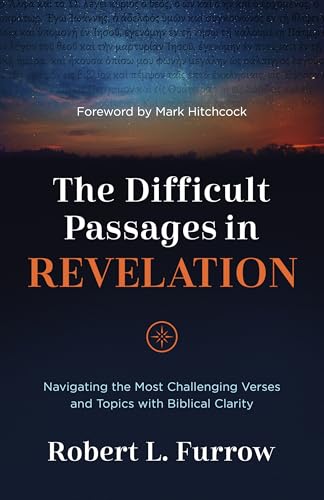
The Difficult Passages in Revelation
Robert L. Furrow
Navigates the most challenging verses and topics in Revelation with biblical clarity and pastoral insight.
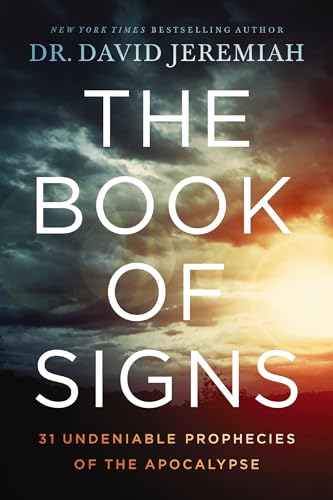
The Book of Signs
Dr. David Jeremiah
31 undeniable prophecies of the apocalypse, helping readers understand the signs of the end times.

The Second Coming
John MacArthur
MacArthur's definitive study of Christ's return — examining the signs, sequence, and significance of the Second Coming from Matthew 24 and Revelation 19.
As an Amazon Associate, Bible Compass earns from qualifying purchases.
Get the 7-Day Holy Week Devotional
Palm Sunday → Resurrection Sunday — free, delivered to your inbox
Related Articles
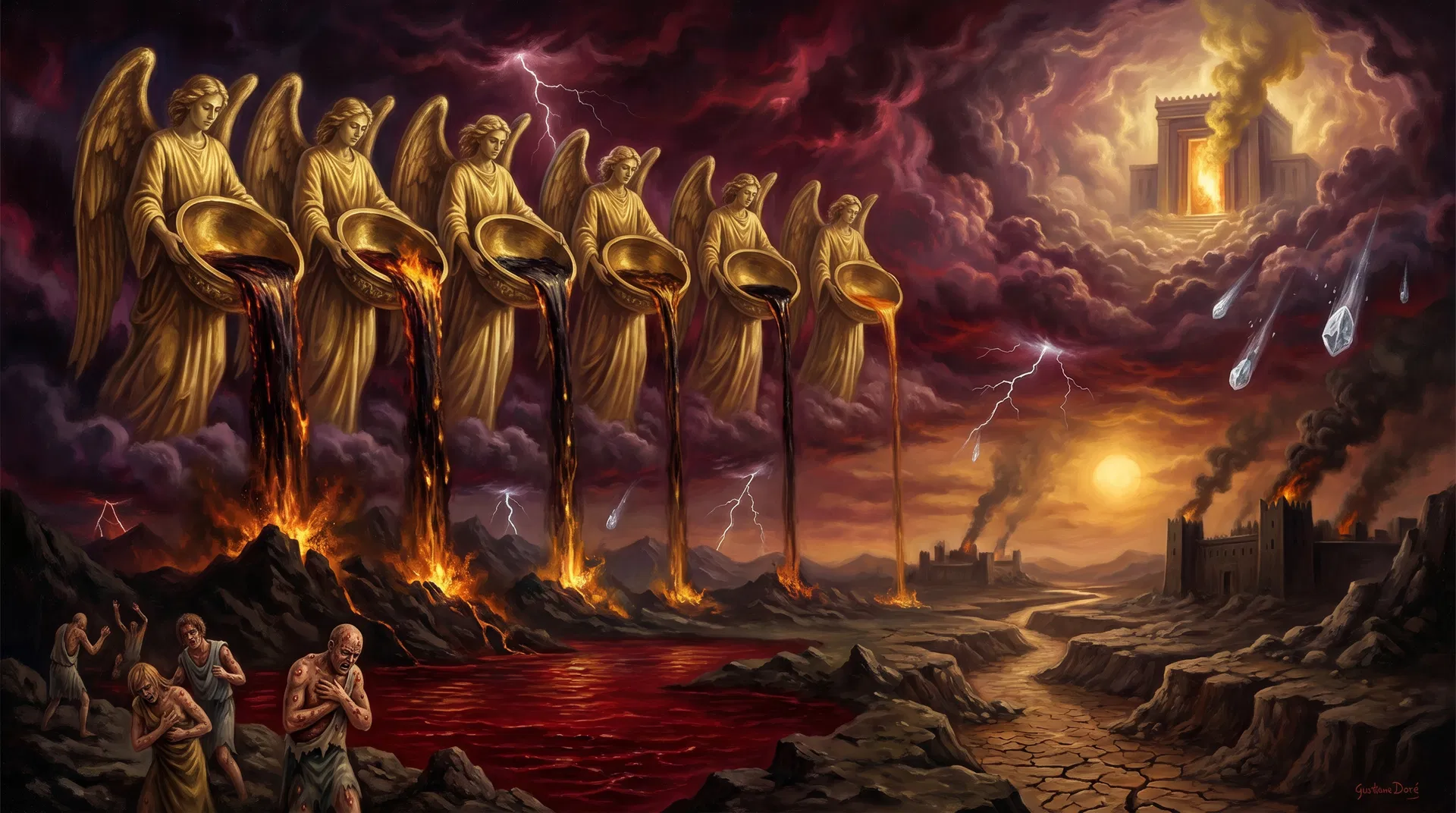
Revelation 15–16: The Seven Bowls of God’s Wrath
The seven bowls of Revelation 15–16 are the final, undiluted judgments of God — more severe than the seals and trumpets combined. This verse-by-verse study unpacks each bowl, the heavenly prelude in Revelation 15, the connection to the plagues of Exodus, and what these chapters reveal about the justice and holiness of God.
Armageddon and the Return of Christ — Zechariah 12–14 and Revelation 19
The final campaign of human history converges on a valley in northern Israel. Zechariah 12–14 and Revelation 19 describe the same climactic moment from two vantage points: the Old Testament prophet who saw it coming and the New Testament apostle who watched it unfold in vision. This verse-by-verse study traces the Battle of Armageddon, the mourning of Israel, and the glorious return of the King of kings.
Revelation 13: The Beast, the False Prophet, and the Mark of 666
Few chapters in the Bible have generated more debate than Revelation 13. This verse-by-verse study unpacks the Beast from the Sea, the False Prophet, and the infamous mark of 666 — with original Greek insights, historical context, and practical application for believers today.
Reader Discussion
(0)Sign in to join the discussion.
No comments yet. Be the first to share your thoughts!
Continue Your Study
Explore the Bible with Scripture-grounded commentary, cross-references, and study tools.